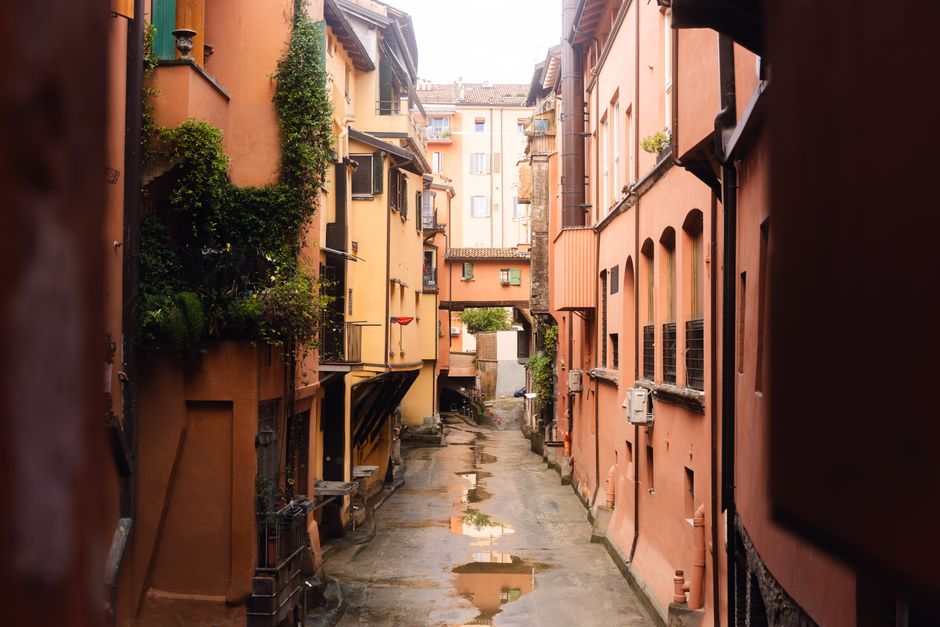
Often skipped by first-time visitors racing between Florence and Venice, Bologna is exactly the kind of city that suits a backpacker's pace. Its centre is compact, its student population keeps prices sensible, and its kilometres of covered walkways mean you can explore comfortably in almost any weather.
What to see
Piazza Maggiore is the heart of the old town, framed by the huge Basilica di San Petronio and the elegant Palazzo. A short walk away, the leaning medieval towers — the surviving Asinelli and Garisenda — are the city's emblem; the taller of the two can be climbed for a view over the terracotta rooftops. The University of Bologna, generally regarded as the oldest in the Western world, gives the whole centre its youthful, unstuffy energy.
The porticoes
Bologna has many kilometres of arcaded walkways, recognised as a UNESCO World Heritage feature. They shelter shops, cafés and pilgrims alike, and following them is a pleasure in itself.
The food quarter
The lanes of the old Quadrilatero market spill over with fresh pasta, cured meats and cheese. This is the birthplace of ragù and tortellini — eating well here does not require a big budget.
Bologna carries several affectionate nicknames that between them sum the city up: la dotta (the learned), for its ancient university; la grassa (the fat), for its cooking; and la rossa (the red), for its terracotta rooftops and long left-leaning political tradition. Wandering the porticoed streets, you feel all three at once — students spilling out of centuries-old faculties, the smell of fresh pasta drifting from doorways, and that warm red brick glowing at sunset. It is a city that reveals itself slowly, which is exactly why it suits travellers who are not in a hurry.
Backpacking on a budget
- Stay central but simple. Hostels and modest guesthouses cluster near the university and station, keeping you within walking distance of everything.
- Eat where students eat. Aperitivo culture, bakery lunches and market stalls let you sample the city's famous food without a restaurant budget.
- Use Bologna as a base. Fast trains reach much of northern Italy, so day trips are cheap and easy from here.
- Walk everywhere. The porticoes make the centre one of the most pedestrian-friendly in the country.
- Look up as well as around. Much of Bologna's pleasure is free — the towers, the frescoed church ceilings and the arcades cost nothing to admire, which stretches a backpacker's money further than in the pricier tourist cities.
The city's student population keeps a genuine budget scene alive year-round, from cheap aperitivo spreads to no-frills osterias where locals eat. That energy, rather than any single sight, is what makes Bologna such a comfortable place to travel cheaply: you are never far from an affordable meal, a lively square or a fellow traveller swapping route notes over a glass of local Sangiovese.
Tower access, museum hours and any climbing arrangements change seasonally and sometimes require booking. Check current details before you travel rather than relying on a fixed schedule.
Good to know
Bologna sits on Italy's main high-speed rail spine, which makes it one of the best-connected cities in the country and a smart hub for a wider Italian trip. The historic centre is flat and easy on foot, so you rarely need public transport within it. Summers are hot and humid; spring and autumn are kinder for long days of walking. As anywhere, keep an eye on your bag in busy market lanes and at the station.
If Bologna is one stop on a longer Italian adventure, our route ideas in backpacking Italy tie the country together, the wider network is covered in exploring Europe by rail, and the full list of ideas lives on the destinations hub.