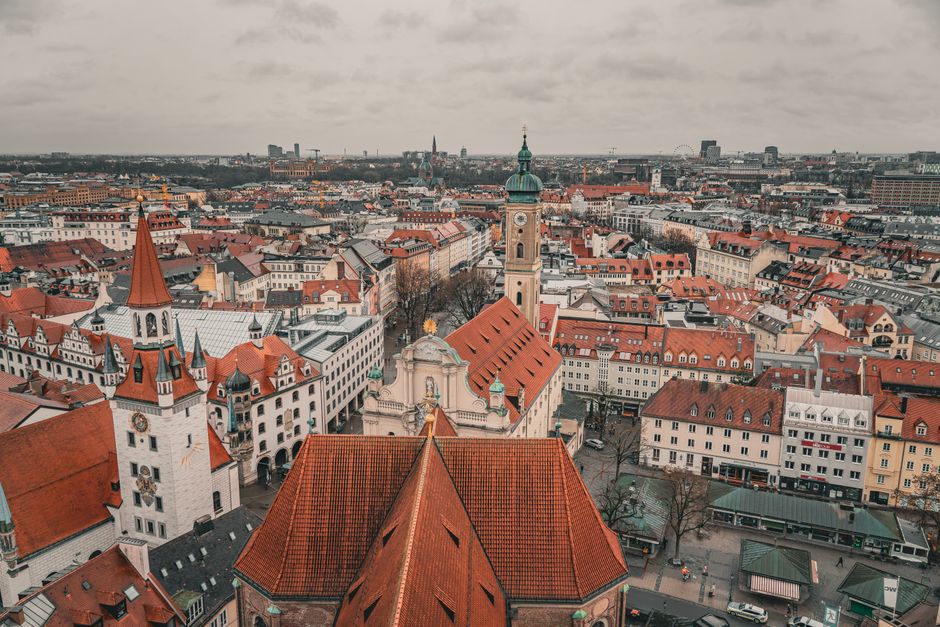
Bavaria's capital manages to feel both grand and relaxed. A single day is enough to sketch its character — imperial squares in the morning, art or gardens in the afternoon, and a long convivial evening. This itinerary keeps walking to a minimum and leans on the excellent public transport.
Morning: the old town
Start at Marienplatz, the central square, where the New Town Hall's Glockenspiel draws a crowd when its figures perform. From here the pedestrian old town unfolds: the twin domes of the Frauenkirche, the Viktualienmarkt food market a couple of minutes away, and a tangle of streets good for a first coffee. Give yourself time to wander rather than rushing between sights.
Midday: art or the Residenz
Munich's museum quarter, the Kunstareal, is a short ride north. The Alte Pinakothek covers old masters, the Neue and the Pinakothek der Moderne carry the story forward into the present day. If you prefer history to galleries, the Residenz — the former royal palace of the Wittelsbach dynasty — is one of Europe's most opulent, with lavish state rooms and a treasury.
Afternoon in the park
The Englischer Garten is one of the largest urban parks in the world — bigger than several famous city parks combined. Its beer gardens, meadows and the surfers riding a standing wave on the Eisbach are a Munich institution.
Evening in a beer hall
The city's beer halls and gardens are social spaces first and tourist stops second. Long shared tables, hearty Bavarian food and locals unwinding make for the most characteristic evening the city offers.
If you have a little longer
Twenty-four hours only scratches the surface, and Munich makes a superb base for more. The BMW Museum and the striking modern architecture of the Olympic Park to the north appeal to anyone interested in design and engineering. Families gravitate to the vast Deutsches Museum, one of the world's largest science and technology collections, which could easily absorb a full day on its own. And because the city sits at the edge of the Alps, day trips to the mountains, to lakeside towns or to the fairy-tale castles of the Bavarian countryside are all within comfortable reach by train. If your schedule allows even a second day, it transforms the trip from a taster into a proper introduction to Bavaria.
Whatever you choose, resist the urge to over-schedule. Munich is a city that rewards sitting still for a while — over a coffee, in a beer garden or on a bench in the Englischer Garten — as much as it rewards ticking off sights.
Good to know
Munich is safe, orderly and easy to read. Many sights cluster in or near the compact centre, so you rarely need more than one or two transit hops. Sundays and public holidays see shops close but museums and gardens stay busy. Bavarian portions are generous, and beer-hall service can be brisk rather than fussy — that is the style, not rudeness. Opening hours and any museum closures shift with the season, so check current details before you travel.
Getting around
The U-Bahn and S-Bahn networks, plus trams and buses, cover everything a visitor needs, and a single day ticket usually pays for itself. The main station and Marienplatz are only a couple of stops apart. From the airport, the S-Bahn reaches the centre in around forty minutes. The old town itself is entirely walkable, so most of your day will be on foot punctuated by short rides.
Munich is a natural gateway to the Alps and to central Europe. If you are threading it into a bigger trip, see our guide to exploring Europe by rail, consider it as one of Europe's best weekend breaks, or browse the full destinations hub for ideas nearby.