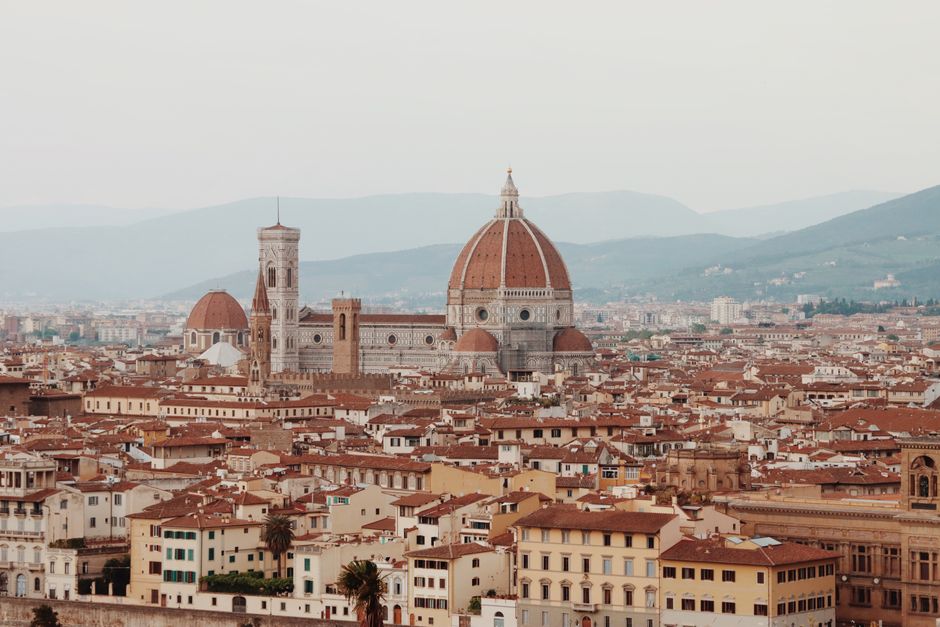
Florence, the capital of Italy's Tuscany region, is one of the great art cities of the world. For a place you can cross on foot in half an hour, it holds a remarkable concentration of masterpieces — the legacy of its role at the very centre of the Renaissance. The five sights below are the ones most visitors build a trip around, and they sit close enough together to see over a couple of unhurried days.
Five to see
1. The Duomo (Cathedral of Santa Maria del Fiore)
Florence's cathedral dominates the skyline with its enormous brick dome, engineered by Filippo Brunelleschi and still, centuries on, an astonishing feat of building. The green, white and pink marble exterior, the adjacent bell tower designed by Giotto, and the octagonal Baptistery with its famous bronze doors together form one of Europe's finest cathedral complexes. Climbing the dome or the tower rewards you with a close-up view over the city.
2. The Uffizi Gallery
One of the most important art museums anywhere, holding a peerless collection of Renaissance painting including works by Botticelli, Leonardo da Vinci, Michelangelo and Raphael. It is deservedly popular, so a timed ticket booked ahead is wise, and even then it pays to allow plenty of time to take it in.
3. Michelangelo's David
The original statue of David stands in the Galleria dell'Accademia; a copy now occupies its former outdoor spot in the Piazza della Signoria, so don't confuse the two. Seeing the real marble in person conveys a scale, poise and level of detail that reproductions never quite manage.
4. The Ponte Vecchio
The medieval bridge over the Arno, lined with shops as it has been for centuries — traditionally the workshops of goldsmiths and jewellers. It famously survived where the city's other historic bridges did not, and remains one of Florence's most photographed and most crowded sights, best enjoyed early or late.
5. Piazzale Michelangelo
A broad terrace on the hillside south of the river, giving the classic panorama over Florence's terracotta rooftops and the great dome. It is a particular favourite towards the end of the day, when the light softens over the whole city.
If you have more time
Five sights barely scratch the surface. The Oltrarno, the quieter side of the river, is full of artisan workshops and less-visited churches, and it climbs towards the Boboli Gardens behind the Pitti Palace. Museum lovers could add the Bargello, strong on Renaissance sculpture, while anyone drawn to the city's ruling Medici family can trace their mark across palaces, chapels and libraries. Tuscany itself is easy to sample on a day out — the walled town of Lucca, the towers of San Gimignano and the countryside of the Chianti hills are all within reach. Even so, Florence rewards not trying to do too much: an hour spent simply sitting by the Arno is time well used.
Good to know
Florence's core is compact and largely walkable, so plan on covering it on foot and wearing comfortable shoes for the cobbles. The headline museums are busy and often require advance, timed tickets; some churches ask for modest dress. Because opening arrangements, closing days and ticketing change regularly, check current details before you travel.